ECMO - CPR
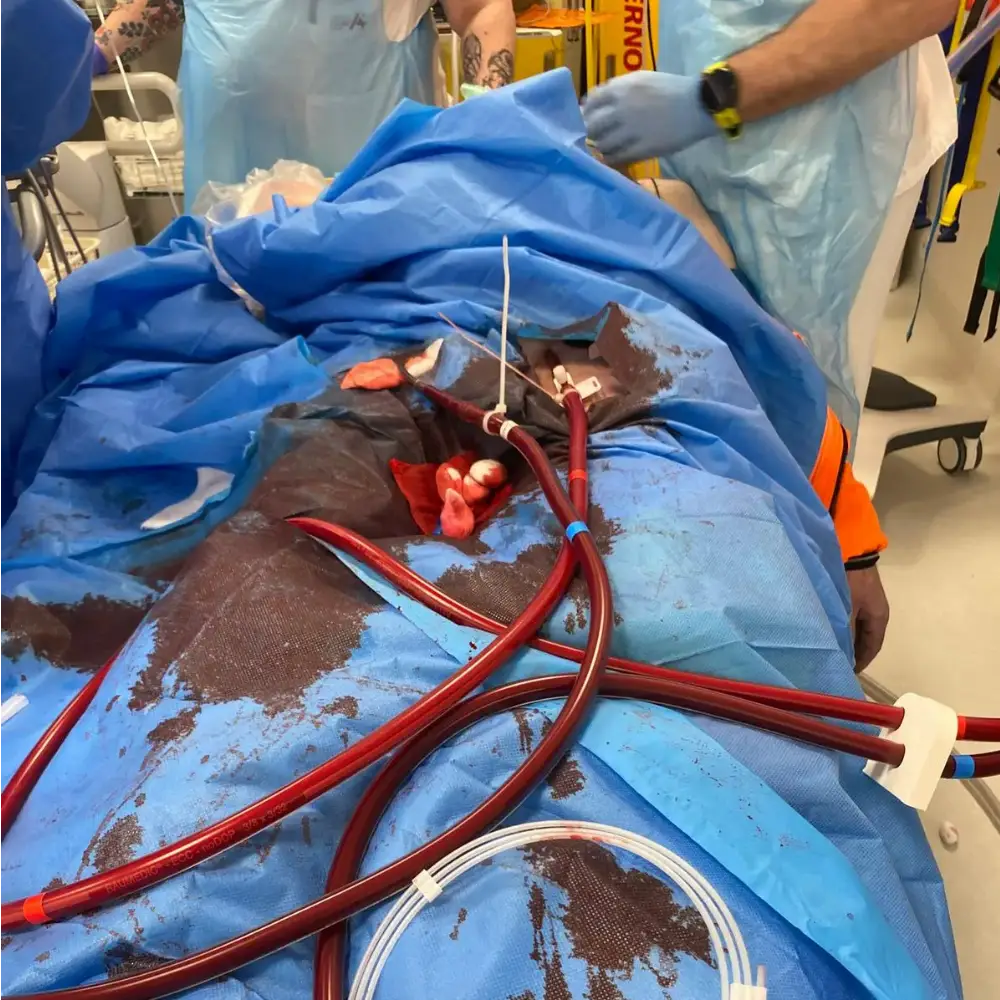
Extracorporeal Membrane Oxygenation (ECMO) represents a method of advanced circulatory support for patients with refractory cardiac arrest in whom standard resuscitation fails. It ensures adequate organ perfusion and provides precious time to address the reversible cause of the condition. The key to success lies in timely indication, minimizing time delays, and seamless coordination between pre-hospital and hospital care. In this algorithm, you will learn to identify suitable ECMO candidates and master the decision-making processes essential for its successful initiation. You will thus gain a clear framework for managing this life-saving technology in critical situations.
Review

Refractory cardiac arrest remains a condition with an extremely poor prognosis despite all advances in resuscitation medicine. Extracorporeal cardiopulmonary resuscitation (eCPR) offers selected patients the possibility of bridging the period of refractory cardiac arrest, maintaining organ perfusion, and gaining time to address a potentially reversible cause. The outcome depends primarily on time—identifying suitable candidates already at the level of the emergency medical dispatch centre, minimizing the low-flow interval, and ensuring seamless coordination between prehospital and hospital-based care. The presented algorithm guides the user through this entire chain, from receiving the emergency call to the decision to initiate ECMO support, in a clear and educational manner and in accordance with current guidelines, which recommend eCPR as a rescue therapy to be considered in selected patients. It should be emphasized, however, that no universally accepted eCPR selection criteria currently exist—they vary between individual centres, and current guidelines do not define them as binding criteria. Optimal candidate selection and the organization of eCPR programmes therefore remain subjects of ongoing research and randomized clinical trials. I consider this algorithm to be a well-structured and clearly presented educational resource and a valuable contribution to teaching this complex and rapidly evolving field.
Sources
SOAR, J., BÖTTIGER, B. W., CARLI, P., CARMONA JIMÉNEZ, F., CIMPOESU, D., COLE, G. et al. European Resuscitation Council Guidelines 2025: Adult Advanced Life Support. Resuscitation. 2025;215(Suppl 1):110769. Available from: https://www.resuscitationjournal.com/article/S0300-9572%25252825%25252900281-3/fulltext
TONNA, J. E., ABRAMS, D., BRODIE, D. et al. Extracorporeal Cardiopulmonary Resuscitation in Adults: Interim Guideline Consensus Statement From the Extracorporeal Life Support Organization. ASAIO J. 2021;67(3):221–228. Available from: https://www.ovid.com/jnls/asaiojournal/fulltext/10.1097/mat.0000000000001344~extracorporeal-cardiopulmonary-resuscitation-in-adults
LORUSSO, R., SHEKAR, K., MACLAREN, G. et al. ELSO Interim Guidelines for Venoarterial Extracorporeal Membrane Oxygenation in Adult Cardiac Patients. ASAIO J. 2021;67(8):827–844. Available from: https://www.ovid.com/jnls/asaiojournal/fulltext/10.1097/mat.0000000000001510~elso-interim-guidelines-for-venoarterial-extracorporeal
BERG, K. M., CHENG, A., PANCHAL, A. R., TOPJIAN, A. A., AZIZ, K., BHANJI, F. et al. 2023 International Consensus on Cardiopulmonary Resuscitation and Emergency Cardiovascular Care Science With Treatment Recommendations: Summary From the Basic Life Support, Advanced Life Support, Pediatric Life Support, Neonatal Life Support, Education, Implementation, and Teams, and First Aid Task Forces. Circulation. 2023;148(24):e187–e280. Available from: https://openrepository.aut.ac.nz/items/dc121aea-7fd8-4d17-b2b2-f3f571947346?utm=
FERRELL, B. E., THOMAS, J., SKENDELAS, J. P., UEHARA, M., SUGIURA, T. Extracorporeal Cardiopulmonary Resuscitation—Where Do We Currently Stand? Biomedicines. 2025;13(1):204. Available from: https://www.mdpi.com/2227-9059/13/1/204?utm
KANG, J. K., DARBY, Z., BLECK, T. P., ROBERTS, B. W., TONNA, J. E., BARTOS, J. A. Post-Cardiac Arrest Care in Adult Patients After Extracorporeal Cardiopulmonary Resuscitation. Crit Care Med. 2024;52(3):483-494. Available from: https://pmc.ncbi.nlm.nih.gov/articles/PMC10922987/
Learning targets
2. The responder knows the indications and contraindications for activating eCPR at different stages of the chain of survival.
3. The responder recognizes the importance of time, teamwork, and interdisciplinary collaboration in eCPR.
Key points
2.The low-flow interval (from the initiation of BLS to connection to ECMO) significantly affects the outcome and should not exceed 60 minutes.
3.Timely transport decisions during high-quality continuous resuscitation are key for a favorable neurological outcome.
4.ECMO ensures adequate organ perfusion and provides time to address the reversible cause of cardiac arrest.
5.Patients who have undergone successful eCPR but have an unfavorable neurological outcome may, if all criteria are met, be included in an organ donation program.